Borsdane Wood and Rayner Park Friends Group
Borsdane Wood and Rayner Park Friends Group is a local volunteer group based in Hindley, Wigan.
We care for and protect two much-loved green spaces – Borsdane Wood and Rayner Park – for the benefit of local people, wildlife and future generations.
We are always happy to welcome new volunteers and visitors.
Who we are
Borsdane Friends Group was formed in 2009, and Rayner Park Friends Group was established in 2018.
Both groups came together in 2022.
We are a local community group of volunteers who care deeply about our green spaces and want to enhance them for everyone who walks, plays, cycles, or spends time enjoying and relaxing in these beautiful areas.
BWRPFG Officers – 2026/2027
CHAIR: Nick Gough
SECRETARY: Barbara Mugan
TREASURER: Catherine Jackson
What we do
We look after Borsdane Wood and Rayner Park by:
- working alongside partner organisations
- organising regular volunteer work sessions
- carrying out practical conservation and habitat management
- litter picking and path maintenance
- supporting wildlife and biodiversity
- organising walks, events and community activities
When and where we meet
We meet every Monday and Thursday at 10am.
Volunteers meet at the Hindley tunnel entrance gate to Borsdane Wood.
All help is always gratefully received.
About the area
Borsdane Wood
Borsdane Wood is to the north of Hindley in the Wigan Borough and is designated as an ancient semi-natural woodland.
There are several entrances to the wood, including access from Hindley via Rayner Park or Hindley Mill Lane. An unadopted road leads to a tunnel under the railway which opens into woodland that has changed little in centuries.
The wood covers approximately 65 acres and is home to many different species of birds, trees, plants and fungi. Much of the woodland has existed continuously since before 1600 and is made up mainly of native tree species.
In 1986, Borsdane Wood became Wigan’s first local nature reserve and remains a highly valued and well-used green space.
Rayner Park
Rayner Park sits next to Borsdane Wood and provides a much-loved open space for the local community.
It includes walking routes, children’s play areas, picnic spots and quieter places to relax.
The park and woodland are separated by Borsdane Brook, which flows on through Low Hall, Hey Brook, Pennington Flash, Glaze Brook, and Manchester Ship Canal to the River Mersey estuary.
WIGAN IN BLOOM 2025:
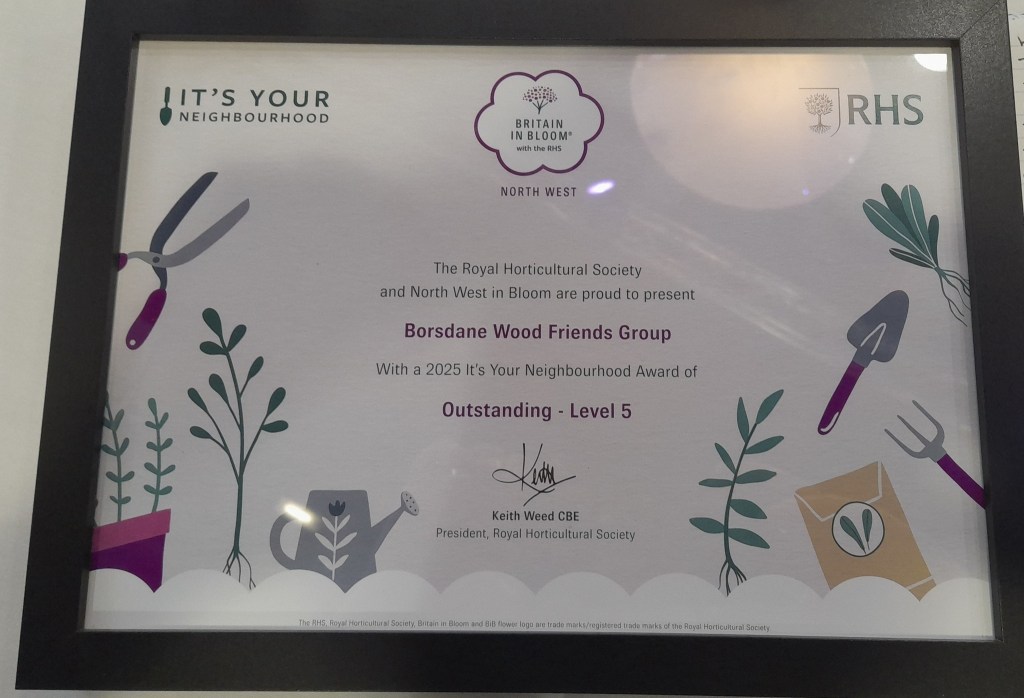
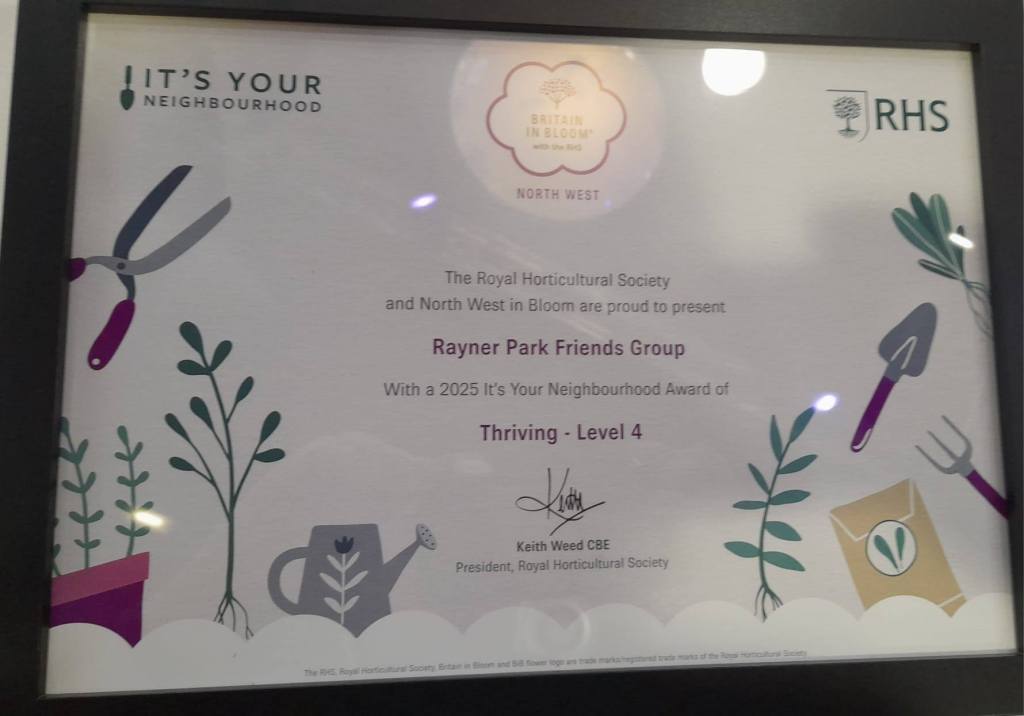
In the 2025 Britain in Bloom North West Awards we were awarded a Level 5 – Outstanding, for our work in Borsdane Wood (for the 6th year running), and a Level 4 – Thriving award, for our work in Rayner Park (for the 4th year running). Great recognition of our volunteers for organising community events and looking after these precious green spaces. Thank you!
Why I volunteer – Catherine Jackson (July 2022)
I started volunteering to give myself a reason to get out on my days off from working. It filled the time I had spare after losing my dog.
I found the more volunteering I did, the more I wanted to get involved. Through volunteering I have met like-minded people who I wouldn’t have ordinarily met. By stepping out of my comfort zone and doing something different I have a new circle of friends who I enjoy spending time with.
I have learnt so much about myself as a person, the area where I live and the nature and wildlife around me. We are extremely fortunate to have so many green spaces in the borough.
Volunteering is extremely rewarding. Many say it is a thankless task, but I disagree. There’s nothing more satisfying than clearing a grot spot of rubbish and leaving it as nature intended.
Being outside and being active is great for the mind too. There’s nothing better than a good litter pick and some fresh air to de-stress.
I’m proud to be a volunteer and will be forever grateful to everyone else who volunteers. Hopefully we can inspire others to get involved too.
THE ANCIENT MAGICAL LAND OF BORSDANE WOOD
Article by Dani Cole in ‘The Mill’, July 2021. Article printed with their permission and our grateful thanks.
The Mill is Greater Manchester’s new quality newspaper delivered by email. To join 50,000 people on their free mailing list and get thoughtful journalism in your inbox every week – click here.
‘We all scramble down the bank to the pebbled riverbed to see the old channel that veers off the brook’s course. It’s no more than a depression in the ground, a ghost-river.’
We’re following the ghosts and relics of the past in Borsdane Wood. Our small troupe is being led through the trees — silver birch, oak, beech, sycamore — by Mick Davies, who seems to know every inch of leaf-littered ground. He has the air of a sage, dressed in a cap and sleeveless jacket, and bearing a bulky camera bag. During the week, Mick, 60, is a laboratory manager for a food company, sometimes putting in 12-hour shifts. When he’s not working, he takes “a hell of a lot of bird photography,” and Borsdane Wood has been one of his regular haunts since he was six years old.
This narrow 1.5-mile stretch of woodland sits in a steep-sided valley in Hindley and it is Wigan’s most extensive ancient woodland. When I phone Wigan Council’s biodiversity officer Kieran Sayer to ask if he could walk me around the wood, he tells me he’ll bring Mick along, as well as Dave Hanbury, a volunteer with the local friends group who care for the woodland in partnership with the council.
Kieran is 25, Dave is 71, and we would look like a motley crew if there was anyone here to see us. As we head deeper into the wood, meadow gives way to green, dappled canopy, and some of the mossy branches of the trees resemble the shaggy tines of stag’s antlers.
The three men settle into a comfortable back-and-forth about the jobs that need doing and the birds they’ve seen here — the kingfisher is the ultimate prize. “It’s the closest thing we’ll get to a tropical bird over here,” Mick says. Kieran tells me about a goshawk that was spotted flying through the wood a few weeks ago. “It’s like a sparrowhawk on steroids.”
Mick stops us along a section of the Borsdane Brook, the river that cuts through the wood and separates Wigan and Bolton. Though it straddles both boroughs, Wigan Council has managed the wood since 1974. Here the brook is shallow, and there are a series of man-made weirs. It was diverted to channel water to feed Hindley Mill, a steam-powered corn mill that was later converted to a cotton mill. This part is known as ‘Flag Bottom’, and Mick points out the natural flagstone jutting up. We all scramble down the bank to the pebbled riverbed to see the old channel that veers off the brook’s course. It’s no more than a depression in the ground, a ghost-river.
Then he fishes out two clear plastic bags packed in with his camera equipment. Out of the first, he takes out what I initially take to be knapped flint — it has an angular, glassy sheen. It’s surprisingly light and smooth in my hands. “There are two things this area is known for,” he says. “Cotton and coal.” Wigan’s coal mining can be traced back to around 1450 and continued into the late twentieth century, with the last coal mines closing in the 1990s. The valley’s shape exposed bedrock and the coal seams that were close to the ground’s surface. Under the headline ‘Mining no threat to woodland’, a Manchester Guardian article from May 1, 1950, reported:
Local authorities have been told by the National Coal Board that there is no threat to Borsdane Wood near Bolton, though there is a possibility of coal mining in the area. It was stated there might be enough coal in the neighbourhood to employ 200 men for 10 years.
Mick tells us that because of pollution, the water used to run “all sorts of colours,” but efforts to clean it up over the years have been rewarded. “It’s full of trout. Big trout,” he says. The second bag contains something more intriguing. “What do you think that is?” he asks, holding up a brown lump. I make a guess. “Dinosaur poo?” Wrong: it’s a fossilised freshwater mussel bed. The rock is cleaved in half, and he opens it, as you would with a clamshell, to reveal a delicate whorl of patterns inside. “This is where the history of the wood starts,” Mick tells us.
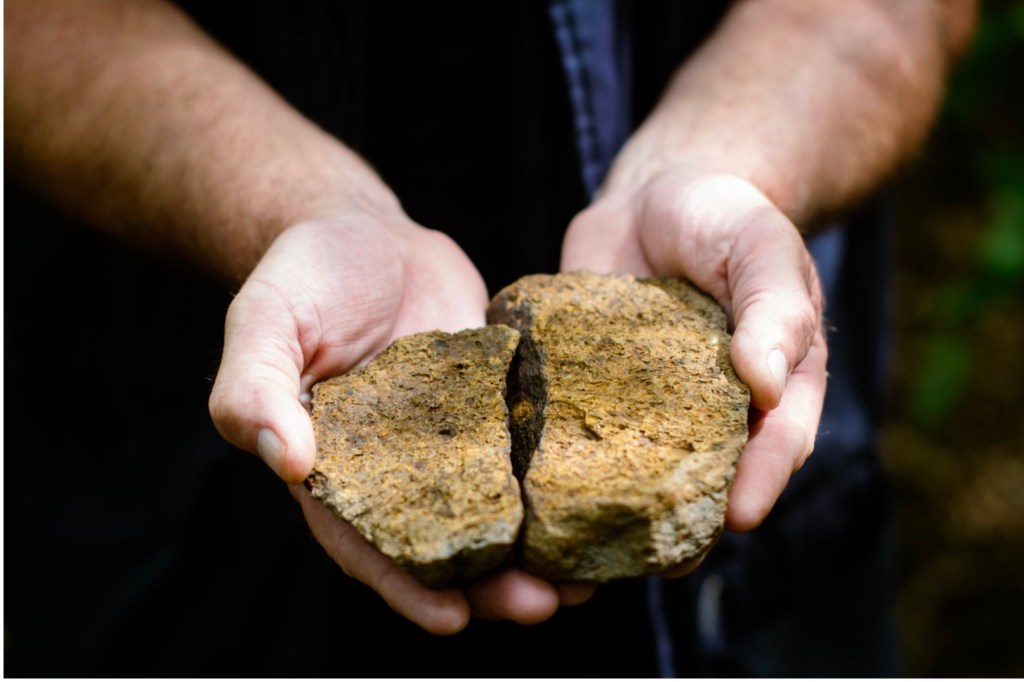
Mick showing the fossilised mussel bed. Photo: Dani Cole/The Mill.
A vestigial forest
Ancient woodland makes up just 781 hectares (around 3 square miles) of Greater Manchester, as identified by the Provisional Ancient Woodland inventory. The definition of ancient woodland is native woodland that has been present since at least 1600, a date that reflects the emergence of the first reliable maps (such as tithe maps), and the fact that there was little recorded planting of woodland before the seventeenth century.
Britain’s post-glacial landscape would have been a scrubby, wind-scoured tundra, interspersed with groves of trees and cropped by herbivores. As the climate warmed, during the Mesolithic era, trees — birch, hazel, lime, elm, hornbeam — started to appear. True wildwood, which covered Britain after the Ice Age, no longer exists. The wildwood in the North was predominantly lime, but Borsdane Wood is perhaps the “nearest natural” remnant of these wildwoods. Because it sits in a sharp, river-carved valley, it’s been left relatively unchanged by human activity. Woodland has long been a resource, exploited for food, fuel and timber. Borsdane is a vestigial forest, a fragment of Britain’s prehistoric landscape.
A large barrow called ‘Boar’s Den’ — a type of prehistoric mound that served as funerary monuments — near Sprodley Brook in Wrightington is commonly thought to be the origin of the woodland’s name. One Victorian writer suggested a connection between Borsdane and ‘Boars Den.’ During Saxon times, drifts of pigs owned by serfs would have roamed the wood, also adding weight to the theory. But in The Place-Names of Lancashire, Eilert Ekwall attributes the first instance of ‘Borsdane’ to ‘Ballesdenebroc’, (Borsdane Brook) in 1215, derived from Old English for ‘Boell,’ a name, and ‘dene’ taken from the Old English of ‘denu’ meaning ‘valley.’
From the fourteenth to the seventeenth century, the wood was part of land belonging to the Langton family of Lowe Hall. J.A. Hilton in North West Catholic History writes that after the Reformation, Hindley was in the “debatable land” of Catholic and Puritan Lancashire. In 1628, Abraham Langton was a “Catholic recusant” and in 1652 he was charged with treason as a “papal delinquent” and his estates — including Borsdane Wood — were sold by parliament. From then, it is thought to have been common land until it passed into the ownership of Hindley Hall Estate, which is now a golf club.
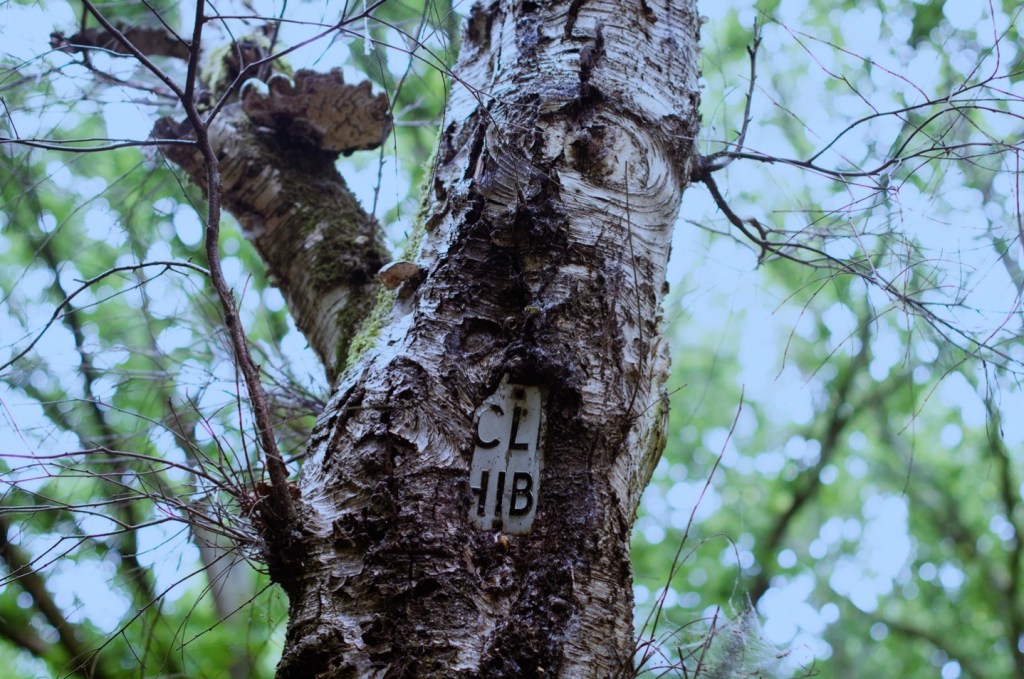
A silver birch tree grows over a ‘Cycling Prohibited’ sign. Photo: Dani Cole/The Mill.
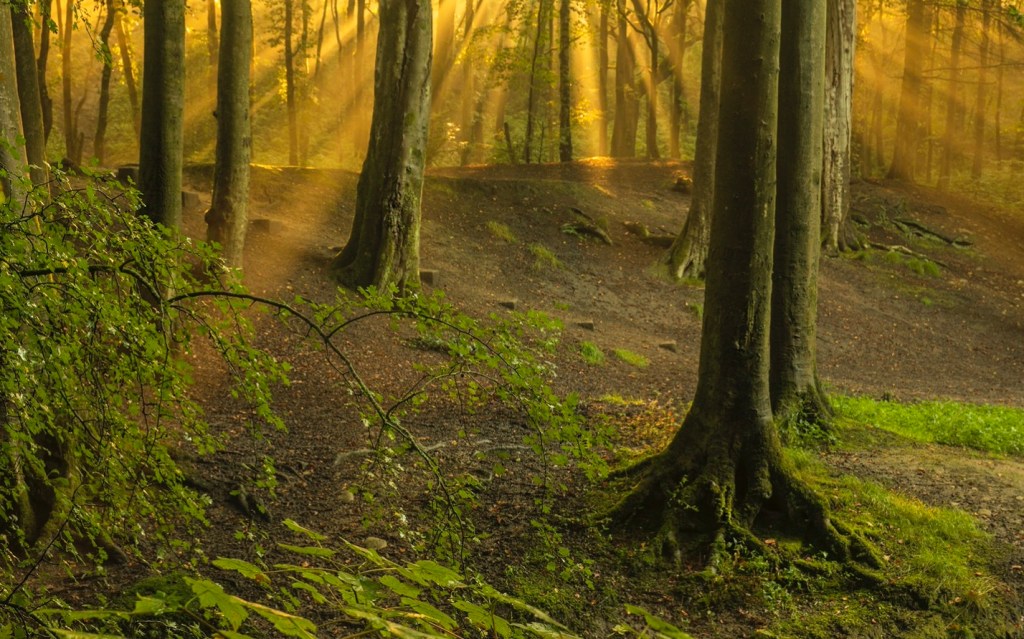
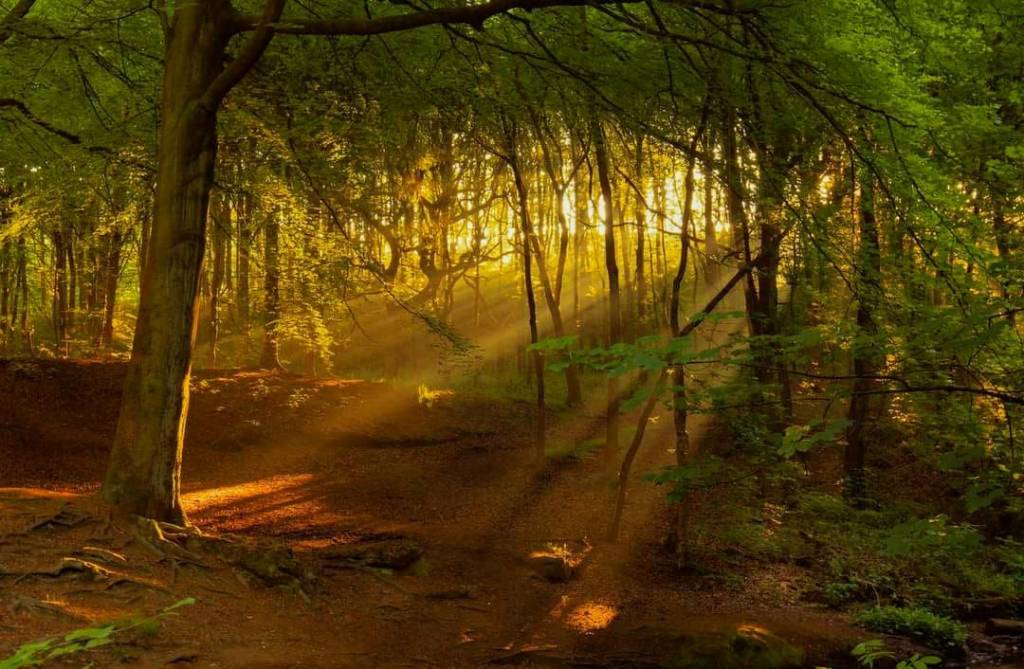
Morning rays of light through the trees. Photo: Mick Davies.
‘All you can hear is birdsong’
This is a broadleaved woodland, which is classed as a “scarce habitat” in Greater Manchester. It’s one of 40 sites in Wigan managed by Kieran and his manager Martin Purcell. Kieran’s path into conservation stemmed from his interest in nature photography. He volunteered with the Lancashire Wildlife Trust and later went on to study ecology and conservation at his local college. “I want to do my bit to try and preserve things,” he says.
“Each habitat supports a different range of species,” he tells me. “It’s the only ancient woodland in the borough.” The ground floor is carpeted with pungent swathes of wild garlic and wood anemone, both ancient woodland indicators. Ancient woodlands like Borsdane — which has 26 species of mammals and 176 species of birds — are incredibly rich with flora and fauna, and are habitats for rare and threatened species.
Among some of the fungi species are the amethyst deceiver, cinnamon porecrust, which darkens from yellow to rust-brown and grows on deadwood, and fly agaric, the distinctive red-and-white topped mushroom often depicted in fairy tales. The abundance of fungi in the wood lures in foragers, which carries risks. “You get people who come and say ‘I can find stuff to cook for my tea,’” Dave says. Mick tells me about the destroying angel which he saw in another wood — it’s a snowy- white mushroom with pale, crowded gills. Once ingested, death can occur within days and there is no known antidote. Fortunately, you won’t find it in Borsdane. The wood is home to the lesser spotted woodpecker. Since 1970, the population is estimated to have fallen by 83% with no more than 2,000 pairs thought to be left in the UK according to the Woodland Trust. The “ongoing loss” of ancient and mature woodland is a “key factor” in its decline, the organisation says. Other rare bird species include the willow tit and the spotted flycatcher. In 1934, a wild bird sanctuary was established in Borsdane Wood, the third in Lancashire at the time. A feeding house with a thatched roof was erected, and it was supervised by wood keeper Herbert J. Evans, who was known for chasing out naughty children who ignored the “no cycling” rule.
Today, errant teenagers are more likely to leave cans and set fire to bins, which is where Borsdane Friends Group step in. “There are some very well-off youths here,” Dave jokes. The community volunteer group was set up in 2009, and they help monitor and maintain the wood, organising educational nature walks and litter picks. Japanese Knotweed and Himalayan Balsam, two invasive species, have crept in between the trees and part of the group’s work now involves balsam bashing. “You can see by the sheer height, nothing has a chance of growing,” Dave says. “It’s so dominant.” Before he retired, he was a mental health nurse working with dementia patients. Borsdane holds great value for him. “It’s a sanctuary — everything is so peaceful. All you can hear is birdsong.”
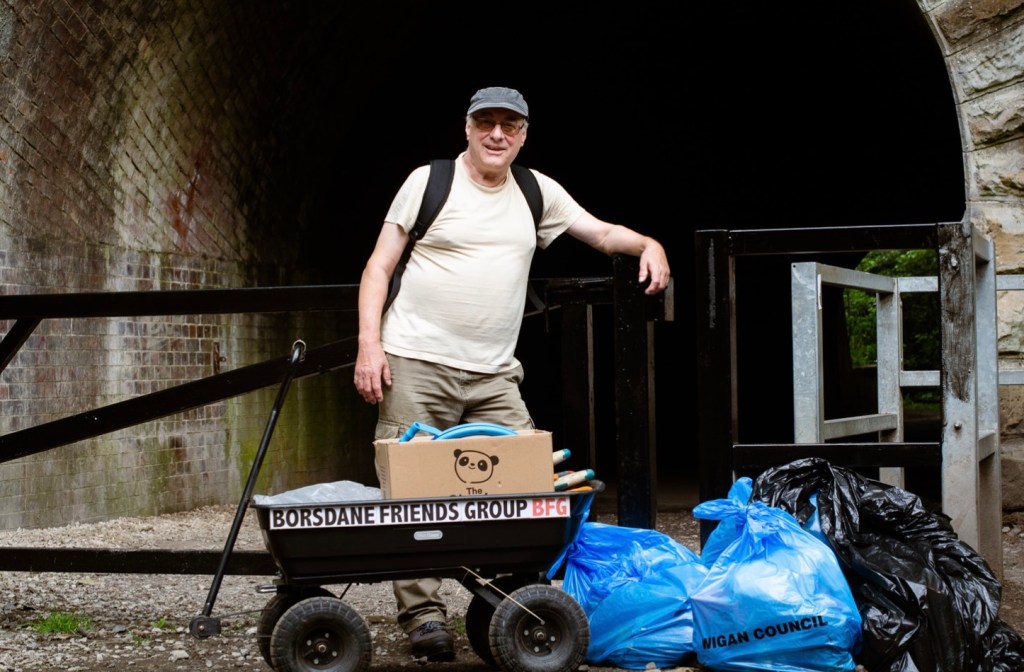
Dave Hanbury, Borsdane Friends Group. Photo: Dani Cole/The Mill.
In 1986, Borsdane Wood became Wigan’s first Local Nature Reserve. This led to the planting of tree species such as Japanese cherry, and western hemlock from north-west America, “like more of a park.” These days the council is focusing on native trees and is considering which species will be climate change resistant. “The biggest risk imported trees have is that they could have pests,” Kieran says. “That’s the major thing. Any trees that have to be imported need to be sprayed and quarantined.”
Restocking and managing the wood is a “massive task” and the stakes are high because ancient woodland is irreplaceable. Centuries of growth and the accumulation of leaf-litter, mosses and lichens have created a complex network of habitats that may never recover once disturbed or impacted. Careful thought needs to be taken to ensure it can thrive for generations to come.
“We’re getting to the point where old trees are beginning to fail,” he says. In their place, new trees will be planted, and these will have to cope with pest disease, drought, and changes in temperature. He points out a horse chestnut that has a fissure twisting up its trunk: this is potato blight. “They get black lines up the main stem,” he explains.
The affected trees will be cut down, but their stumps will be left as deadwood. “It’s part of a functioning woodland that trees die,” he reassures me. “Ecology is never black and white.” There are other challenges to consider. Young trees planted at other sites in Wigan have been targeted by vandals who have uprooted them. “It’s a lot to think about,” he says. “We’re trying to stick to as much heritage as we can.”
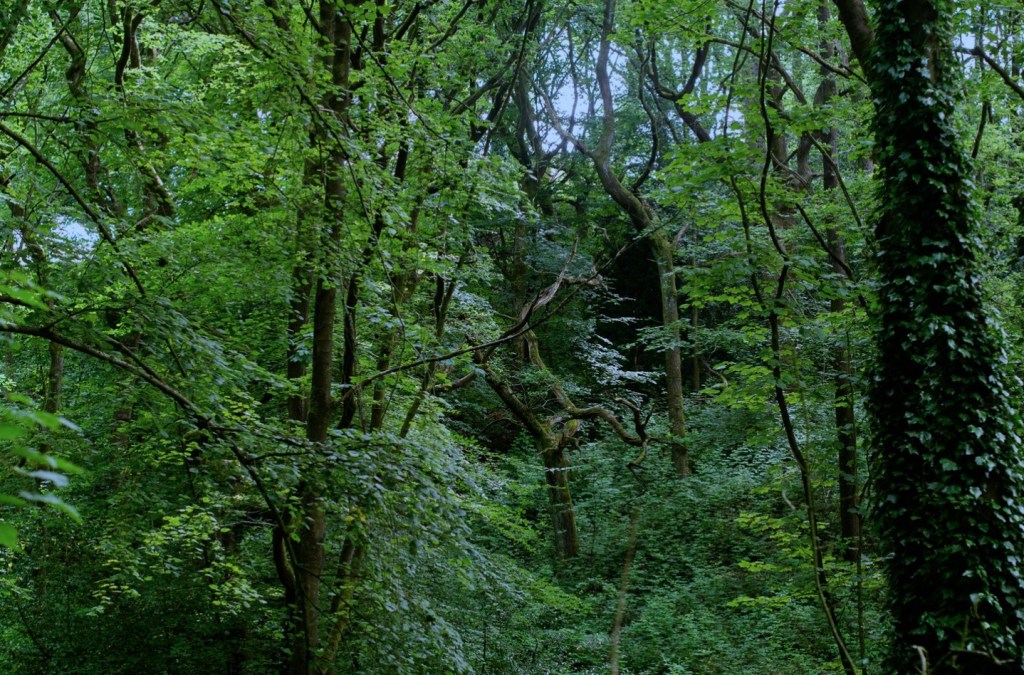
Trees in Borsdane Wood. Photo: Dani Cole/The Mill.
There is also ash dieback — caused by a devastating fungus Hymenoscyphus fraxineus — in the wood. The spores are carried in the wind, and one estimate predicts it will kill four fifths of the ash trees across the UK — a species that is sacred in Celtic and Norse cultures; the mighty ash Yggdrasil is the World Tree in Viking mythology. In British folklore, the ash possessed healing and protective properties against witchcraft. Newborn babies were given a teaspoon of ash sap to ward off ill health.
The tree is considered a good omen and also had its uses in deploying charms. In Lancashire, a woman who wanted to know who her husband would be pulled an even-ash leaf from the tree and incanted: “Even-ash, even-ash, I pluck thee/ This night my own true love to see.” But there is some positive news: “Some of the ash seems to be resisting,” Kieran says. He’s come along with a pair of binoculars, and every so often lifts them up to look at a tree to see if it is suffering from the disease.
We’ve almost reached the end of the walk and Mick has one last surprise to share. “I’m going to take you to a farmer’s field,” he beckons. “But not as you know it.” He leads us to a sunny glade where the ground undulates gently. I’m not sure what I’m looking at until he tells me the slight brows are an example of ridge-and-furrow farming, a technique dating back to the Medieval period.
We say our goodbyes on Hindley Mill Lane, and I walk away with the feeling that I’ve spent the afternoon not just in a woodland, but in the far-distant past.
Borsdane Wood and Rayner Park Friends Group (BWRPFG) Joint AGM
Tuesday 6th February 2024
Held at THRIVE, Market St, Hindley at 6.30pm
Attendees: Dave Hanbury – DH (Chair), Janet Wilcock – JW (Secretary), Councillor Paul Blay, Hindley
Ward – CPB, Lauren Littler-Murdoch – LLM, Barbara Mugan – BM, Chris Mugan – CM, Jean Jones – JJ,
Mark Forristal, LWT – MF, Cathy Higgins – CH, Louis Dunkerley – LD, Mick Davies – MD
Apologies: Catherine Jackson, Nick Gough, Kerry Garforth, Julie Bennett, Chris Hardman, Kieran
Sayer
DH welcomed everyone and thanked them for coming along to this joint AGM. DH explained that the
group’s Treasurer, Catherine Jackson, was working this evening and was unable to attend as was
Nick Gough, one of the group’s regular work party volunteers, who was currently away on holiday.
PB and MD both advised that, because of other commitments, they may have to leave the meeting
early. In view of this, DH set out the format of the meeting as follows:
1. Review of the group’s achievements in 2023
2. Appointment of Officers
3. Future Plans for 2024 and beyond
Review of 2023:
The aim of the group at the start of the year was to engage and integrate with the local
community, encouraging outdoor activity in our local park and woods and to be inclusive for all. The
group feel that this was achieved by the following events and activities which took place during the
year.
• Strawberry Fair in July. This was by far the biggest event organised by the BWRPFG. Despite
a poor weather forecast, the event was well attended and thoroughly enjoyed by all.
Fairground rides, a bouncy castle and magical story telling from Professor Jigget provided
lots of fun for the children and SambAfriq had everyone enthralled with their amazing music
and dance routines. In addition, there were many community and local business stalls to
peruse and free rides and refreshments provided for the children.
• The exhibition of photographs taken by local photographers, Mick Davis and Olly Hitchen,
and held in St John’s Church in April was well attended and created a lot of interest in the
community, bringing back lots of memories of walks in the woods and local history for many
of those who visited the exhibition.
• Once again, Dave Winnard (Discover The Wild) led six guided nature walks through the
woods during the year, covering a variety of subjects. These always create a lot of interest
from the community with many people, young and old, attending the walks.
• Professor Jigget returned to Borsdane Wood in August to keep the children (and many grown
ups too) spellbound once again with his magical tales.• The Borsdane Wood and Rayner Park website has continued to attract lots of visitors to its
pages throughout the year. Ideally we could do with an experienced person to maintain it.
• The group’s Facebook page continues to grow its membership (now nearly 3,400!) and
attracts some great photography and much interest.
• Both Borsdane Wood and Rayner Park entered the Wigan In Bloom Competition again. For
the third year running Borsdane Wood achieved a Level 5 (Outstanding) award whilst Rayner
Park, entered for the second year, achieved a Level 4 (Thriving) award.
• Throughout the year, the BWRPFG volunteers had collected thousands of bags of rubbish
from their litter picking work parties and it is much appreciated by the local community. In
addition to their litter picking activities in Borsdane Wood, Rayner Park and South Rayner,
the group have also continued to litter pick the area around Borsdane Precinct for which they
receive payment, raising very useful funds for the group. DH wanted to give special thanks
to Chris Hardman, Nick Gough, and Barbara Mugan for their regular and much appreciated
contribution to the weekly work parties.
Annual General meeting – Election of Officers:
Chair – Dave Hanbury
Secretary – Janet Wilcock
Treasurer – Catherine Jackson
All proposed, voted in and agreed by all present.
Updates, future plans and events for 2024 and beyond:
• Lancashire Wildlife Trust in conjunction with Wigan Council have continued to support the
BWRPFG. MF confirmed they would continue to do so and was planning for more work on the
meadow area and elsewhere in Borsdane Wood to further reduce the Himalayan Balsam.
• The path near Flag Bottom is in need of upgrading due to continued water erosion. Also, the
loose logs laid out in a circle in this area could become a hazard so may require some
attention.
• We are still determined to create a wheelchair friendly path to the metal table on the first
meadow area, and funding will be sought to repair many of the paths in the woods in Rayner
Park.
• It was agreed that the St John’s Church Photography Exhibition would take place between 15
May and 2nd June. This time it will be open to all amateur photographers and be a
celebration of all Wigan’s Green Spaces. MD and DH to discuss the finer arrangements in
more detail at a separate meeting.
• Dave Winnard has been booked for seven guided nature walks during 2024. These will be
advertised on the BWRPFG website, Facebook page, and appropriate display boards.
• An event similar to the 2023 Strawberry Fair is hoped for and needs to be planned – date
and details to be discussed.• Professor Jigget will be asked to return to entertain us with his amazing story telling.
• We will continue to develop further collaboration with other local community groups and
local schools including Friends of Hindley Chapel, Friends of Low Hall, Friends of Hindley
Station, and Castle Hill School amongst many others.
• Wigan in Bloom entries for 2024 to be submitted for both BW and RP.
• To enable the group to develop further, it would be helpful if the following roles could be
filled by volunteers:
o IT expert to maintain the BWRPFG website.
o Bid writer.
o Event Planners.
• Whilst not directly related to Borsdane Wood/Rayner Park, there are currently meetings
taking place to discuss a Landscape Recovery Scheme, looking at obtaining national funding
to connect all green spaces and habitats around the borough. This is likely to be a twenty-
year project and several organisations will be involved including Lancashire Wildlife Trust,
Natural England, DEFRA and the Forestry Commission. There is a meeting at St Peter’s
Pavilion on Monday evening (Feb 12th) where the public will be able to ask questions and
give their comments and views on the proposals.
In Memory:
Before closing the meeting, the BWRPFG would like to send their heartfelt condolences to Councillor
John Vickers whose wife Sue sadly died recently and will be greatly missed by not only this group,
but many in the wider community.
Treasurers Report:
Monies in accounts at 7th February 2024 –
Borsdane Friends Group – £984 Rayner Park – £1056
Accounts will be prepared to financial year end 31/03/24 in due course.
The Chair thanked all for attending and the meeting was brought to a close at 8.15pm.
 Borsdane Wood and Rayner Park Friends Group